
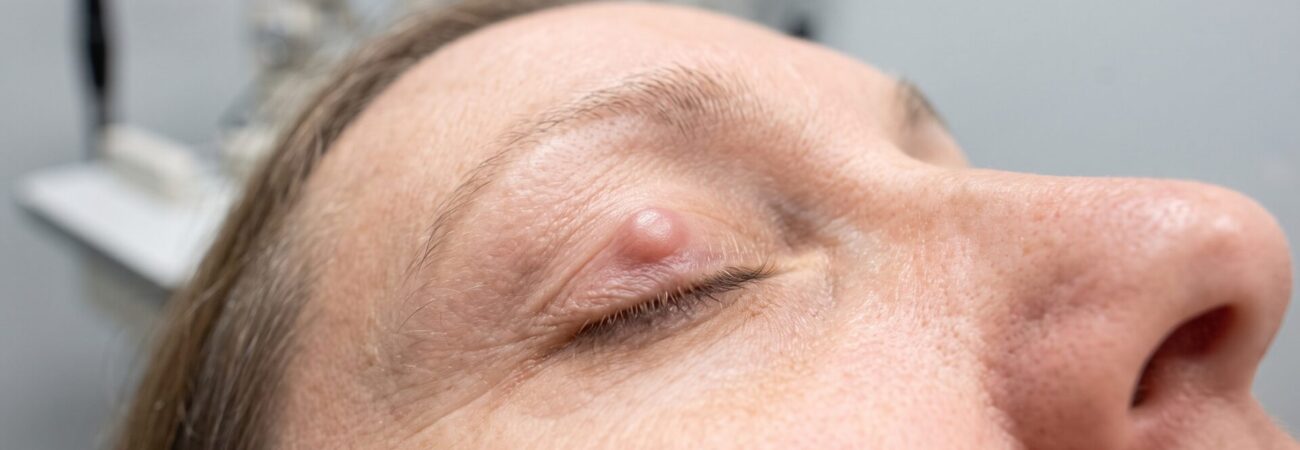
The lump turned up about three weeks ago. You assumed it was a stye, held a warm washer over it morning and night and waited for it to come to a head. It never did. It also never really hurt. It just sat there, firm and quietly stubborn, a little higher up the lid than a stye usually sits.
That lump is most likely a chalazion, and the reason your stye routine has not shifted it is simple. It was never an infection to begin with.
What Is a Chalazion?
A chalazion is a firm lump in the eyelid caused by a blocked oil gland, not by an infection. Along the inner edge of each eyelid sit dozens of tiny meibomian glands, which release the oily layer that stops your tears evaporating too quickly. When one blocks at the opening, the oil has nowhere to go.
The gland swells, the trapped oil leaks into the surrounding tissue, and your immune system treats it as a foreign substance and walls it off. What you feel is a granuloma: a firm nodule of contained inflammation rather than a pocket of pus.
More than one is called chalazia. Your GP may have written meibomian cyst on the referral, which is the same thing. Some people search for it as an eye chalazion or a chalazion cyst, though “cyst” undersells how solid these feel.
Blockage, not infection. That distinction explains why antibiotics often do nothing and why the lump can outlast every other eyelid problem you have had.
Chalazion vs Stye: How to Tell the Difference
The quickest test is pain and position. A stye hurts and sits right on the lash line. A chalazion is usually painless and sits further back in the lid, so you can often feel it more easily than you can see it.
| Chalazion | Stye (hordeolum) | |
| Cause | Blocked meibomian gland, sterile inflammation | Bacterial infection of a lash follicle or oil gland |
| Pain | Usually painless, sometimes tender early on | Painful and tender, often throbbing |
| Location on the lid | Set back from the lash line, within the lid | On or very near the lash line |
| Onset speed | Gradual, over days to weeks | Fast, over one to two days |
| Duration | Weeks to months | Days to a couple of weeks |
| Treatment | Warm compresses, massage, sometimes a procedure | Warm compresses, occasionally antibiotics |
Healthdirect describes a stye as a small painful lump caused by a bacterial infection of an eyelash follicle, which usually settles on its own with warm compresses.
Here is the part that confuses almost everyone searching hordeolum vs chalazion at 11pm. An internal stye can turn into a chalazion. An internal stye is an infected meibomian gland. Once your immune system clears the bacteria the pain goes and the redness fades, so everyone assumes it is over. But if the gland is still blocked, oil keeps backing up and the body walls off what is left. The infection resolved. The plumbing problem did not.
So a sore lump a month ago and a painless firm bump in the same spot today is not a sign anything went wrong. One condition handed over to the other. If your lump is hot, sore and sitting on the lash line, our guide to what causes styes and how to treat them safely covers that side of it.
What Causes a Chalazion?
Chalazion causes come down to one mechanism: a meibomian gland opening becomes blocked, usually because the oil inside has thickened or the gland margin is inflamed. Everything else is a risk factor that makes that blockage more likely.
- Blepharitis, chronic inflammation along the eyelid margins. The strongest and most common link.
- Meibomian gland dysfunction, where the oil produced is thicker and waxier than it should be.
- Rosacea and seborrhoeic dermatitis, which both affect oil gland behaviour in the skin.
- A previous chalazion, particularly in the same gland.
- Chronic lid inflammation from any cause, including long-term allergy.
- Eye rubbing and heavy eye makeup, especially waterline products sitting over the gland openings.
Now the honest part. Plenty of chalazia appear in people with none of the above. No blepharitis, no skin condition, no bad habits, just one gland out of roughly a hundred deciding to misbehave. If you have been hunting for the thing you did wrong, there may not be one.
Chalazion Symptoms
The classic chalazion symptom is a firm, painless lump set back from the lash line that appeared over days rather than overnight. Most people notice it by touch or in the mirror before it causes any real trouble.
- A round, well-defined nodule inside the eyelid that moves slightly with the skin.
- Mild tenderness or redness in the first few days, which settles even though the lump stays.
- Heaviness in the lid, most noticeable with a chalazion on the upper eyelid.
- A gritty feeling, as though there is an eyelash you cannot find.
- Watery eyes, or crusting if blepharitis is part of the picture.
A chalazion under the eyelid on the lower lid tends to bother people less, because there is less lid movement pressing it against the eye. Then the symptom people are surprised by: chalazion blurry vision. A large chalazion on the upper eyelid can press against the front of the eye and change the shape of the cornea slightly, inducing astigmatism. Vision goes soft or doubled in that eye and often shifts when you blink. It is not damage and it usually resolves once the lump does, but it is a good reason to have the eye assessed rather than waiting it out.
If your main complaint is discharge and crusting rather than a lump, our article on what gunky eyes are telling you is a better starting point.
Chalazion Healing Stages: What to Expect
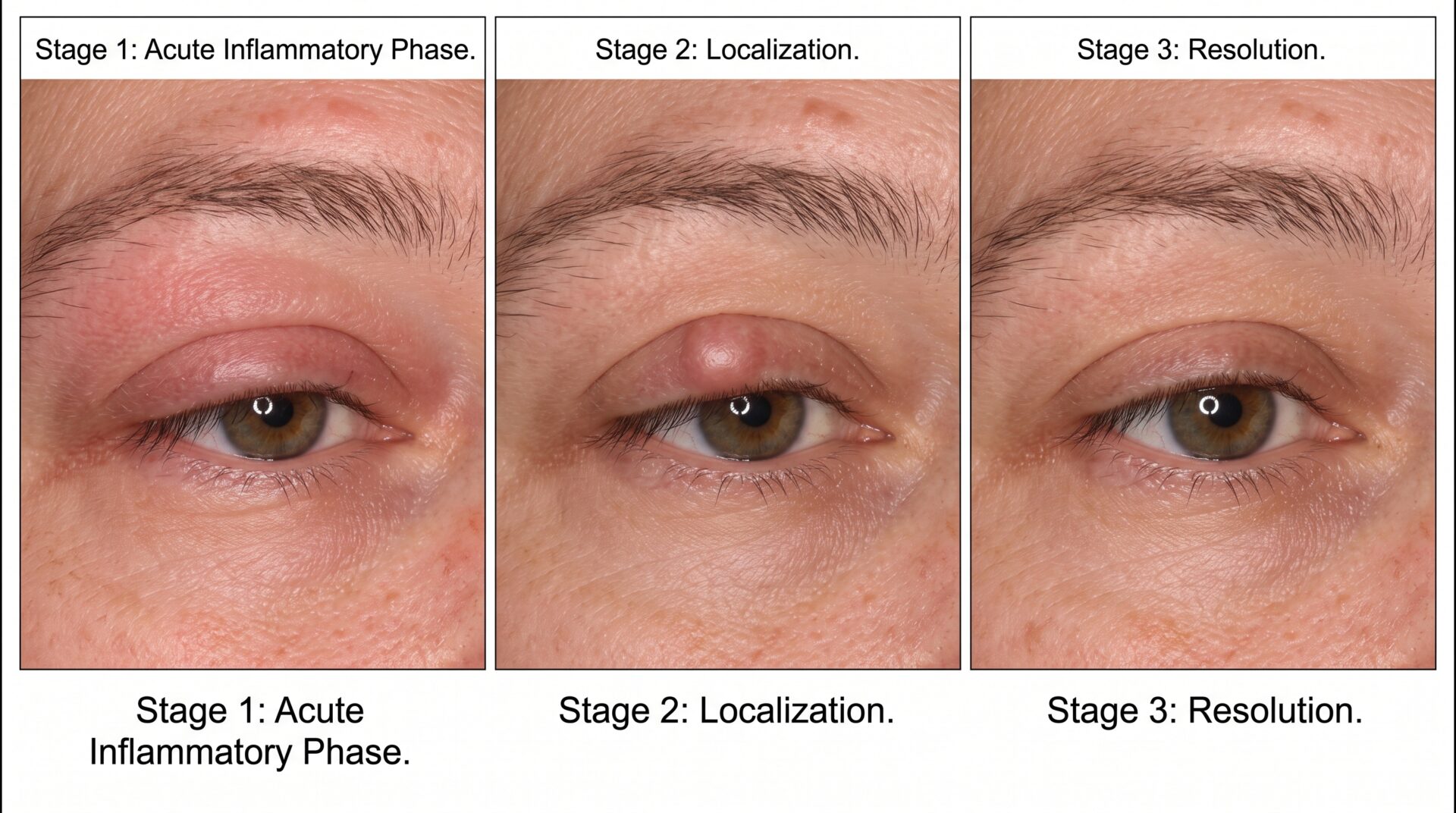
Chalazion progression runs through four rough stages: soft diffuse swelling, a firming stage where it becomes a defined nodule, a plateau where nothing appears to change, then slow shrinking over weeks to months. The plateau is the stage that sends people to the internet.
Early swelling (days 1 to 5). The lid feels puffy and slightly tender. Hard to tell from a stye here, and warm compresses do the most good.
Firming (week 1 to 3). Tenderness settles, the swelling concentrates and you can feel a distinct pea-like nodule. The granuloma is forming.
Plateau (weeks to months). No pain, no growth, no shrinking. Frustrating, but not a sign anything is wrong.
Resolution or persistence. Many chalazia shrink away over one to three months. Some take up to six. A minority need a procedure.
So will a hardened chalazion go away on its own? Often, yes, but the firmer and older it is, the slower and less certain that becomes. Once one has been stable for two to three months of consistent warm compresses, waiting longer is rarely productive.
Chalazion draining on its own does happen, usually inward through the lining of the lid rather than through the skin. What you notice is oily discharge, a softer lump and a gritty eye for a day. Do not force it. Squeezing pushes inflammatory material into the surrounding tissue and reliably makes things worse.
Not sure what you are looking at? A short lid examination will tell you whether that lump is a chalazion, a stye or something that needs a closer look. Book an eye exam at EyeSelect in Browns Plains or Forest Lake.
How to Treat a Chalazion
Chalazion treatment starts and often ends with heat and massage. The goal is to melt the thickened oil blocking the gland so it can drain, which means the compress has to be genuinely warm and held there long enough to matter.
Warm compresses
Use a heat pack or a clean flannel run under hot tap water, comfortably hot but never scalding. Hold it against the closed lid for five to ten minutes, three to four times a day. A flannel loses useful heat in about a minute, so re-warm it two or three times a session. Two lukewarm minutes before bed does nothing, which is the most common reason home treatment “fails”.
Lid massage
Straight after the compress, while the oil is soft, sweep firmly along the lid with a clean fingertip toward the lash line. Upper lid, sweep down. Lower lid, sweep up. Ten to twenty strokes, pressure on the lid and not the eyeball.
Lid hygiene
Clean the lid margins daily with a lid wipe or diluted lid cleanser. If blepharitis is in the background, this is the part that stops the next one forming.
On antibiotics
A chalazion is not an infection, so antibiotic drops and ointments do not treat it. They are prescribed when one becomes secondarily infected or when the diagnosis is actually an internal stye. Oral doxycycline is sometimes used for recurrent chalazia in people with rosacea, but that works by changing how the oil glands behave rather than by killing bacteria.
Clinical options
If a chalazion persists past two to three months, is large or is affecting vision, there are two standard next steps. A steroid injection settles the inflammation and shrinks it over a few weeks. Incision and curettage is a short procedure under local anaesthetic, done from inside the lid so there is no visible scar.
Both are performed by an ophthalmologist. We confirm the diagnosis on the slit lamp, rule out the conditions that imitate a chalazion, manage it conservatively while that is the right call and refer you on if it needs draining.
When to See an Optometrist
Book an appointment if the lump has not changed in a few weeks, if it is affecting your vision or if anything about it is painful or spreading.
- Present beyond three to four weeks with no sign of shrinking despite consistent warm compresses.
- Vision is blurred, distorted or changes when you blink.
- Recurring chalazia, particularly in the same spot on the same lid.
- Pain, spreading redness across the lid or cheek, or a fever. That points towards a stye or cellulitis and needs same-day attention.
- The lump is bleeding, ulcerated, has distorted the lid margin or caused lash loss. Rarely, eyelid lumps are something other than a chalazion, and persistent atypical lesions should always be examined.
- You are not sure what it is. That is a reasonable reason to book.
If the whole eye is red rather than just the lid, our guide to what bloodshot eyes actually mean is worth reading alongside this.
How to Prevent Recurring Chalazia
The most effective prevention is treating the blepharitis or gland dysfunction underneath. People who get one chalazion are more likely to get another, and in almost every recurrent case there is an inflamed lid margin driving it.
Build a lid hygiene routine
Warm compress plus a lid margin clean, once daily if you are prone to blockages. Two minutes at the bathroom sink. Unglamorous, and it works.
Keep on top of blepharitis
It is chronic rather than curable, so the routine continues after symptoms settle. Stopping when your lids feel fine is how the cycle restarts.
Rethink makeup habits
Skip waterline eyeliner, which sits over the gland openings. Remove eye makeup fully every night, replace mascara every three months and never share it.
Consider omega-3
Some research suggests omega-3 improves the quality of meibomian oil, though the evidence is mixed and the effect modest. Worth discussing rather than treating as a fix.
Manage related skin conditions
Treating rosacea or seborrhoeic dermatitis properly usually improves the lids too.
Frequently Asked Questions
How do I know if it’s a stye or chalazion?
Pain and position give it away. Painful, fast-growing and on the lash line points to a stye. Painless, slow-growing and set back in the lid points to a chalazion. If it started sore and became a painless firm lump, it was probably both in sequence.
How do you get rid of a chalazion fast?
There is no fast option at home, but heat applied properly is the closest thing. Five to ten minutes of sustained warmth followed by firm massage toward the lash line, three to four times daily, gives the gland its best chance of draining. Stubborn ones clear fastest with a steroid injection or incision and curettage.
Why did I suddenly get a chalazion?
Usually one meibomian gland blocked, often for no identifiable reason. Blepharitis, rosacea, heavy eye makeup and eye rubbing raise the odds, but plenty of people develop one with none of those present.
Do chalazions hurt when you blink?
Not typically. A larger one can feel like pressure or heaviness as the lid moves, and there may be tenderness in the first few days. Sharp pain on blinking suggests infection or a corneal issue and should be checked.
Can a chalazion go away on its own?
Many do, usually over one to three months and sometimes up to six. The firmer and older it is, the less likely that becomes, which is why a lump unchanged for a couple of months is worth reviewing.
Is a chalazion contagious?
No. There is no infection involved, so there is nothing to pass on through contact, shared towels or close proximity.
Can I wear makeup or contact lenses with a chalazion?
Pause both until it settles. Makeup blocks the gland openings you are trying to clear, and a lump on the upper lid can shift a contact lens or make it uncomfortable. Glasses for a few weeks is the easier path.
Can children get chalazia?
Yes, and they are common in kids. The same warm compress approach applies, but children need review sooner because a large upper lid chalazion can blur vision during the years when eyesight is still developing.
Get That Eyelid Lump Checked
A painless eyelid lump is rarely serious, but three months of guessing is a long time when a short examination can tell you what it is and what will shift it.
Our optometrists at both locations can diagnose a chalazion, separate it from a stye or other lid lesions, set up a lid care routine that works and refer you on if it needs draining. Comprehensive eye exams are bulk billed through Medicare for eligible patients.
Browns Plains (Grand Plaza Shopping Centre): 07 3800 8700
Forest Lake: 07 3278 7341
This article is for educational purposes and is not a substitute for professional optometric advice. Book an appointment for a personalised assessment.