

By the time most people hear the words binocular vision dysfunction, they’ve been round the loop a few times. A GP visit. Possibly a scan. A migraine script that took the edge off without ever stopping it. Two or three eye tests that came back perfectly normal, which somehow felt like the least reassuring result of the lot.
If that’s you, here’s the first thing worth saying. You’re not imagining this and you’re not a difficult patient.
The symptoms tend to cluster the same way. Headaches that build through the day. Dizziness in the supermarket aisle. Car sickness as a passenger when you never used to get it. Reading the same paragraph four times and still not holding any of it.
That cluster gets labelled a lot of things. Vestibular migraine. Anxiety. Vertigo. ADHD. Sometimes nothing at all. Occasionally the label fits. Often it’s close but not quite, because what’s driving the symptoms is a small mechanical problem in how your two eyes work as a pair, and a routine eye test isn’t built to find it.
What Is Binocular Vision Dysfunction?
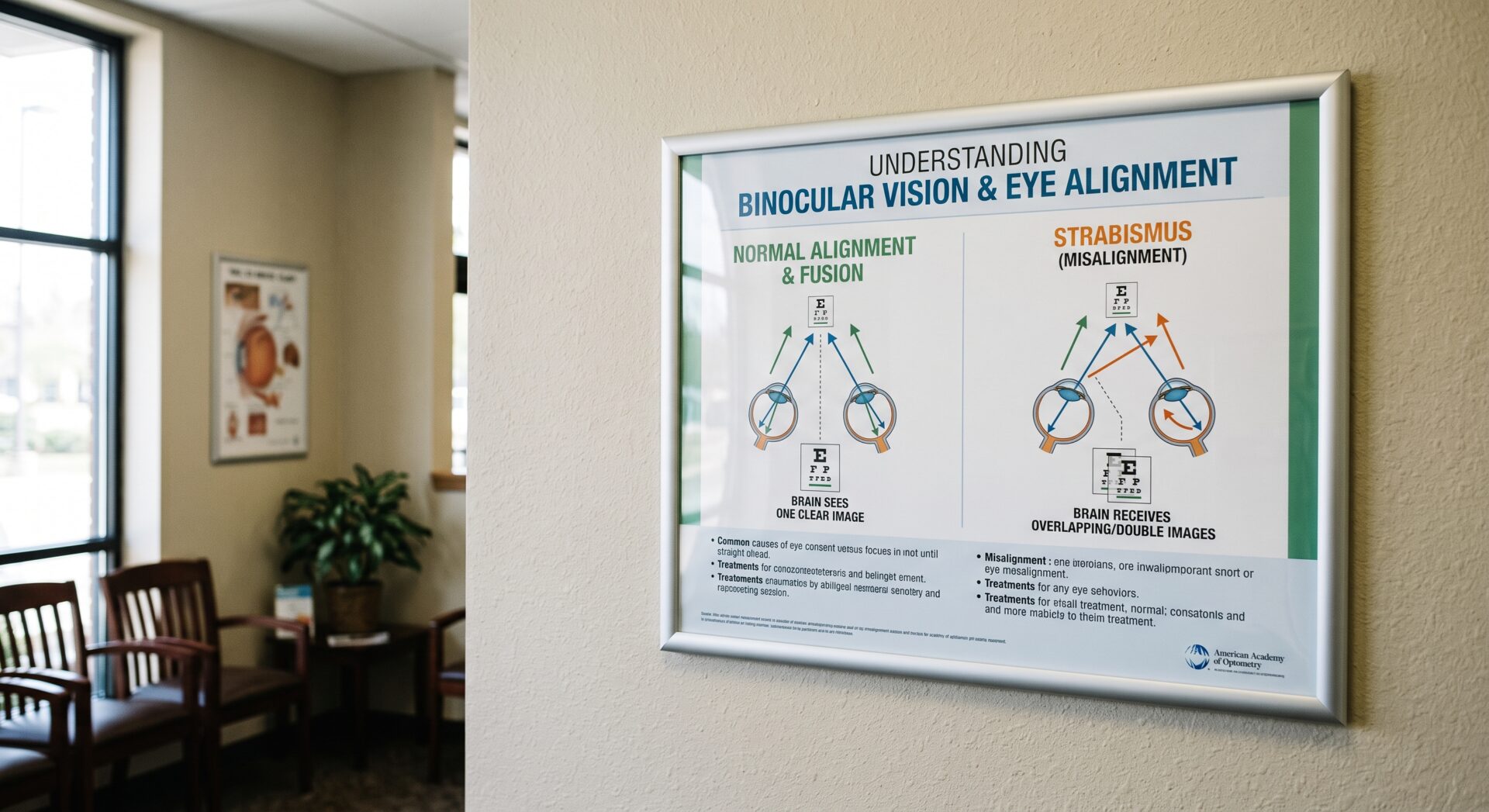
Binocular vision is just your two eyes working as one system. Each eye picks up a slightly different image and your brain fuses them into a single, stable, three-dimensional picture. For that to happen, both eyes have to aim at the same point at the same time.
In binocular vision dysfunction, the aim is slightly off. Your eye muscles spend the day dragging those two images back into line so your brain can fuse them, and you never feel it happening.
That’s the bit worth holding onto: the symptoms come from the effort, not from the misalignment. Your visual system is working an overtime shift from the moment you open your eyes, and the headaches and fatigue are the bill for it.
Here’s what catches people out. The misalignment behind a binocular vision disorder is usually tiny, often a fraction of a degree. You’d never see it in the mirror and nobody at home would notice it either.
So it gets missed, and not because anyone did a poor job. A standard eye test answers two questions: does each eye see clearly, and is each eye healthy. Both answers can be a confident yes while your eyes are still failing to team up properly, because that’s a third question and it takes different testing to answer.
Symptoms of Binocular Vision Dysfunction
Binocular vision dysfunction symptoms almost never turn up as an obvious eye problem. They arrive as head symptoms, body symptoms or concentration problems, which is a big part of why people spend years chasing the wrong diagnosis.
Head and body
Headaches around the temples, forehead or behind the eyes, usually worse by mid-afternoon. Dizziness, or a floaty, unsteady feeling that comes and goes. Nausea. Motion sickness in the car, on escalators or watching movement on a screen. Balance problems, drifting sideways when you walk, clipping door frames.
Vision
Double or overlapping vision, though most people describe it as shadowing or ghosting rather than proper doubling. Blur that clears if you blink hard. Light sensitivity, especially under fluorescents. Trouble judging distance, which shows up on steps, kerbs and when you’re parking.
Reading and screens
Losing your place mid-line. Words that shimmer, swim or slide. Skipping lines without meaning to. Eyes that ache or water after twenty minutes of close work. Covering one eye to hold the text still, which is the one patients usually mention last and it’s often the most telling.
Everyday situations
Supermarket aisles are the classic trigger, because tall shelves full of repeating patterns give your visual system almost nothing to lock onto. Crowds, wide open spaces and night driving with headlights coming at you tend to do the same thing.
If you’re reading this nodding along, keep a rough tally. The number of boxes you tick is genuinely useful information for the optometrist you see next.
The ADHD overlap
This one comes up in our practice regularly, so it’s worth talking about.
A child whose eyes can’t comfortably hold alignment at reading distance will avoid reading. They fidget, lose their place, rush their homework and complain of headaches. From the other side of the classroom, that looks like inattention. Adults with the same problem tend to call it brain fog.
BVD and ADHD are separate conditions and neither one causes the other, and plenty of people have both. But the attention symptoms of an uncorrected eye teaming problem look enough like ADHD that they get confused, and an eye teaming assessment is a reasonable thing to tick off before or alongside a behavioural one.
What Causes Eyes to Stop Working Together?
There’s no single cause. Most of what we see falls into a handful of categories.
Phoria and Heterophoria
A phoria is a misalignment that’s there but hidden. Left to itself, one eye would drift off position, but your brain won’t accept a double image, so it holds the eye in place using the vergence muscles.
Most people have a small phoria and go their whole life without noticing. It only becomes a problem when the correction your eyes need is more than your system can comfortably supply.
That’s why symptoms flare late in the day or during a rough week. Fatigue, illness, stress, a few drinks and long screen days all eat into your reserve. If your headaches are worse on Thursday than Monday, that’s a pattern.
Esophoria and Exophoria
These two just describe which way the eye wants to drift.
Esophoria is an inward drift, towards the nose, so your system works to hold the eye out. It’s commonly tied to heavy near work and it makes reading feel tight.
Exophoria is an outward drift, away from the nose, so your system works to pull the eye in. It bites hardest during reading and close screen work.
There’s also vertical phoria, where one eye sits slightly higher than the other. It’s less common, and it’s the one most strongly linked with dizziness, motion sickness and neck strain, so it’s worth knowing about if those are your main complaints.
Convergence Insufficiency
Convergence is the inward turn your eyes make when you look at something close. Convergence insufficiency means they struggle to hold that turn.
The pattern is distinctive. Distance vision feels fine, then symptoms build within minutes of reading or picking up your phone. Words blur or double, one eye drifts out and closing an eye brings instant relief.
It’s one of the most common binocular vision problems in school-aged kids and it responds well to treatment, which is a genuinely good piece of news for parents. The mechanism deserves a fuller explanation than we can fit in here.
Esotropia vs Exotropia
The difference between a phoria and a tropia is simple and worth remembering.
A phoria is hidden. The eye stays aligned because your brain is actively holding it there.
A tropia is visible. The eye is genuinely turned and the brain isn’t correcting it. Esotropia turns inward. Exotropia turns outward.
Tropias are easier to spot but not always easier to treat. Some only show up when a person is tired or concentrating hard, which is why family photos are so often where somebody first notices.
Other Causes
Head injury and concussion. Eye teaming problems are common after concussion, whiplash or any solid knock to the head. Symptoms can turn up weeks later and get put down to lingering post-concussion syndrome. If your symptoms started after an accident, say so at your appointment, because it changes what we look for.
Stroke and neurological conditions. Damage to the nerves that steer the eye muscles will change alignment. Multiple sclerosis, myasthenia gravis and thyroid eye disease can all present this way.
Cranial nerve problems. Three cranial nerves run the eye muscles. If one of them is compressed, inflamed or injured, alignment shifts with it.
No identifiable trigger. For a lot of patients there’s no injury and no illness at all. The phoria was always there and something tipped the balance: a new job with more screen time, a change in glasses, ageing, or a stretch of poor sleep you never quite recovered from.
Seek Immediate Medical Attention
Sudden onset double vision isn’t an optometry booking. It’s an emergency.
Go to a hospital emergency department now if double vision comes on suddenly, particularly alongside any of these:
- A drooping eyelid
- A severe or unusual headache
- Facial droop, or weakness or numbness on one side of the body
- Difficulty speaking, confusion or trouble walking
- A pupil that has changed size
These combinations can point to a stroke, an aneurysm or a cranial nerve palsy. Don’t wait for an appointment. Call 000 or go straight to your nearest emergency department.
What Causes Double Vision?
Double vision comes in two types and you can tell them apart in about ten seconds.
Binocular double vision disappears the moment you cover either eye. It only exists when both eyes are open, so each eye is seeing perfectly well on its own and the problem is alignment. This is the type that goes with phorias, tropias and binocular vision dysfunction.
Monocular double vision sticks around when you cover the other eye. The affected eye still sees two images by itself, which points to something inside that eye: cataract, dry eye, an irregular cornea, keratoconus or a high uncorrected astigmatism.
The one-eye-covered test
Next time you notice the doubling, cover one eye with your palm.
- Doubling stops with either eye covered: binocular double vision, an alignment issue.
- Doubling continues in one eye on its own: monocular double vision, something within that eye.
- Doubling started suddenly, or comes with any red flag above: stop testing and get urgent medical care.
Make a note of which it was and tell your optometrist. It’s a small detail that changes where we start looking.
How Binocular Vision Dysfunction Is Tested
A standard bulk-billed eye exam is good care. It checks the health of your eyes, screens for disease and works out the prescription you need to see clearly. What it isn’t built to do is measure how your eye teaming holds up over a full day of use, and there’s rarely time in a routine appointment to sit down and find out.
A binocular vision assessment adds that measurement. Here’s what actually happens in the chair.
Cover test
We cover one eye, uncover it and watch what the eye does as it takes fixation back. A drift and a recovery tells us there’s a phoria. A movement that doesn’t recover tells us there’s a tropia. We do it at distance and at reading distance, because plenty of people are comfortable at one and struggling at the other.
Vergence range measurement
We hold increasing prism in front of your eyes and record where you first notice blur, then where you see double, then where you pull it back to a single image. Those three numbers describe your reserve. The pattern our optometrists see most often in symptomatic patients isn’t a dramatic misalignment, it’s a normal-looking snapshot with almost no reserve left behind it.
Near point of convergence
We bring a target slowly in towards the bridge of your nose and note where one eye gives up and drifts out. Then we repeat it several times, because a system that fatigues on repetition tells us far more than a single measurement does.
Prism measurement
Once we’ve found a misalignment, we quantify it in prism dioptres and check the direction, horizontal or vertical. That’s the number that ends up in a lens, so we take it across several viewing distances rather than trusting one.
We also use dedicated BVD symptom screeners before any of the testing starts. A structured questionnaire on headaches, dizziness, reading habits and motion sensitivity often points us at the problem before the equipment comes out, and it gives us a baseline to measure your treatment against later.
Two practical notes for Australian patients. These appointments run longer than a standard eye test, because the testing is deliberately repetitive. And you don’t need a referral from your GP. You can book straight in with an optometrist.
If this sounds like your last few years, book a binocular vision assessment. Our optometrists at Browns Plains and Forest Lake will take the time to measure how your eyes work together, not just how clearly each one sees. Call Browns Plains on 07 3800 8700 or Forest Lake on 07 3278 7341. You can also book online.
Treatment for Binocular Vision Dysfunction
Prism Lenses
A prism is a wedge built into a spectacle lens. It bends light before it reaches your eye, which shifts where the image lands.
Put the image where your eye is already aiming and the muscles don’t have to haul it into line any more. The effort stops, and for a lot of patients the headaches and dizziness stop with it.
The correction is usually small and you can’t see it in the finished lens. Prism goes into single vision, multifocal and occupational prescriptions with whatever tints and coatings you already wear, and we fit it as part of our specialist glasses range.
Now the honest part. Prism relieves symptoms by compensating for the misalignment. It doesn’t repair it. Some patients need the amount adjusted at follow-up visits as things settle, and a few find the effect fades and needs revisiting. That’s a normal part of the process, not a treatment that failed.
Vision Therapy
Vision therapy is a structured program of exercises that trains your eye teaming and focusing systems to hold alignment on their own.
It works best for convergence insufficiency and for younger patients, where the evidence behind it is strongest. Expect weekly sessions with daily exercises at home over several months.
It asks more of you than a pair of glasses does, and the results track pretty closely with how consistently the home exercises get done. For the right candidate it’s the option that addresses the mechanism instead of compensating for it.
Tinted and Occupational Lenses
Visual stress is the extra load your system carries from glare, flicker and high-contrast patterns. Take that load off and the misalignment underneath becomes much easier to live with.
A light tint softens fluorescent lighting and screen glare, which is why so many BVD patients say the office is worse than home. Occupational lenses are built around a set working distance, so you’re not tipping your head back hunting for the clear zone of a general multifocal all day.
Neither one corrects alignment. Paired with prism, they’re often what makes the difference between coping at work and not.
When to Book an Assessment
Book a binocular vision assessment if any of this sounds familiar.
- Headaches or dizziness that have gone on for months, with normal results from your GP, imaging or a standard eye test
- A child with 20/20 vision who avoids reading, loses their place or gets headaches after homework
- Any new symptoms after a head knock, concussion, whiplash or car accident
- Motion sickness or supermarket dizziness that’s clearly worse than it was a year ago
- Double or shadowed vision that improves when you cover one eye
- Reading fatigue that hits within twenty minutes and eases when you close one eye
The rule of thumb we use: if your symptoms have visual triggers but nobody has measured how your two eyes work together, that measurement is worth having.
Frequently Asked Questions
What are the symptoms of binocular vision dysfunction?
Headaches, dizziness, motion sickness, double or overlapping vision, light sensitivity, losing your place while reading, poor depth perception and discomfort in busy places like supermarkets. Symptoms usually get worse through the day and with sustained reading or screen use.
How do you test for BVD at home?
You can’t diagnose it at home, but you can work out whether an assessment is worth booking. Count how many of these apply: headaches most days, unexplained dizziness, car sickness as a passenger, losing your place while reading, covering one eye to read, discomfort in supermarkets or crowds and normal results from previous eye tests. Three or more is reason enough to come in.
Can you fix binocular vision dysfunction?
Symptoms can usually be managed very well. Prism lenses compensate for the misalignment and often cut symptoms substantially. Vision therapy can improve the underlying eye teaming in suitable patients, particularly children and young adults with convergence insufficiency. A permanent cure isn’t guaranteed and some patients need ongoing adjustments.
Is BVD a symptom of ADHD?
No. They’re separate conditions that can happen together. The confusion comes from the fact that uncorrected eye teaming problems produce inattention, reading avoidance and restlessness that look a lot like ADHD, particularly in children.
Can children have BVD?
Yes, and it’s often missed because children assume everyone sees the way they do, so they never mention it. Watch for reading avoidance, head tilting, covering an eye, skipping lines, homework battles and headaches after school. A child can have perfect 20/20 vision and still have a significant binocular vision problem.
Does a standard eye test detect BVD?
Usually not. A standard exam checks eye health and clarity of sight, and both can be completely normal in someone with BVD. Picking it up takes specific eye teaming tests including cover testing, vergence ranges and near point of convergence, and those need more chair time than a routine appointment allows.
Do you need a referral for a BVD assessment in Australia?
No. Optometrists are primary care practitioners here, so you can book directly without seeing your GP first. If the testing points to a neurological cause, we’ll refer you on to an ophthalmologist or back to your GP.
How much does a BVD assessment cost?
Comprehensive eye exams at EyeSelect are bulk-billed through Medicare. A binocular vision assessment adds testing time and equipment beyond that standard exam, so an additional private fee may apply depending on what your case needs. Fees change, so give us a call for current pricing and we’ll tell you exactly what your appointment includes.
Get Your Eyes Measured as a Pair
If you’ve collected a stack of normal test results and you still feel unwell, the measurement nobody has taken yet might be how your two eyes work together.
Both EyeSelect locations offer binocular vision assessments. Call us at Browns Plains on 07 3800 8700 or Forest Lake on 07 3278 7341, and you can also book online. Mention that you’d like a binocular vision assessment so we can set aside the extra time.
No referral needed. Bring your previous test results along if you’ve got them.
This article is for educational purposes and is not a substitute for professional optometric or medical advice. Book an appointment for a personalised assessment. If you experience sudden double vision, a drooping eyelid, facial weakness or a severe headache, seek emergency medical care immediately.