

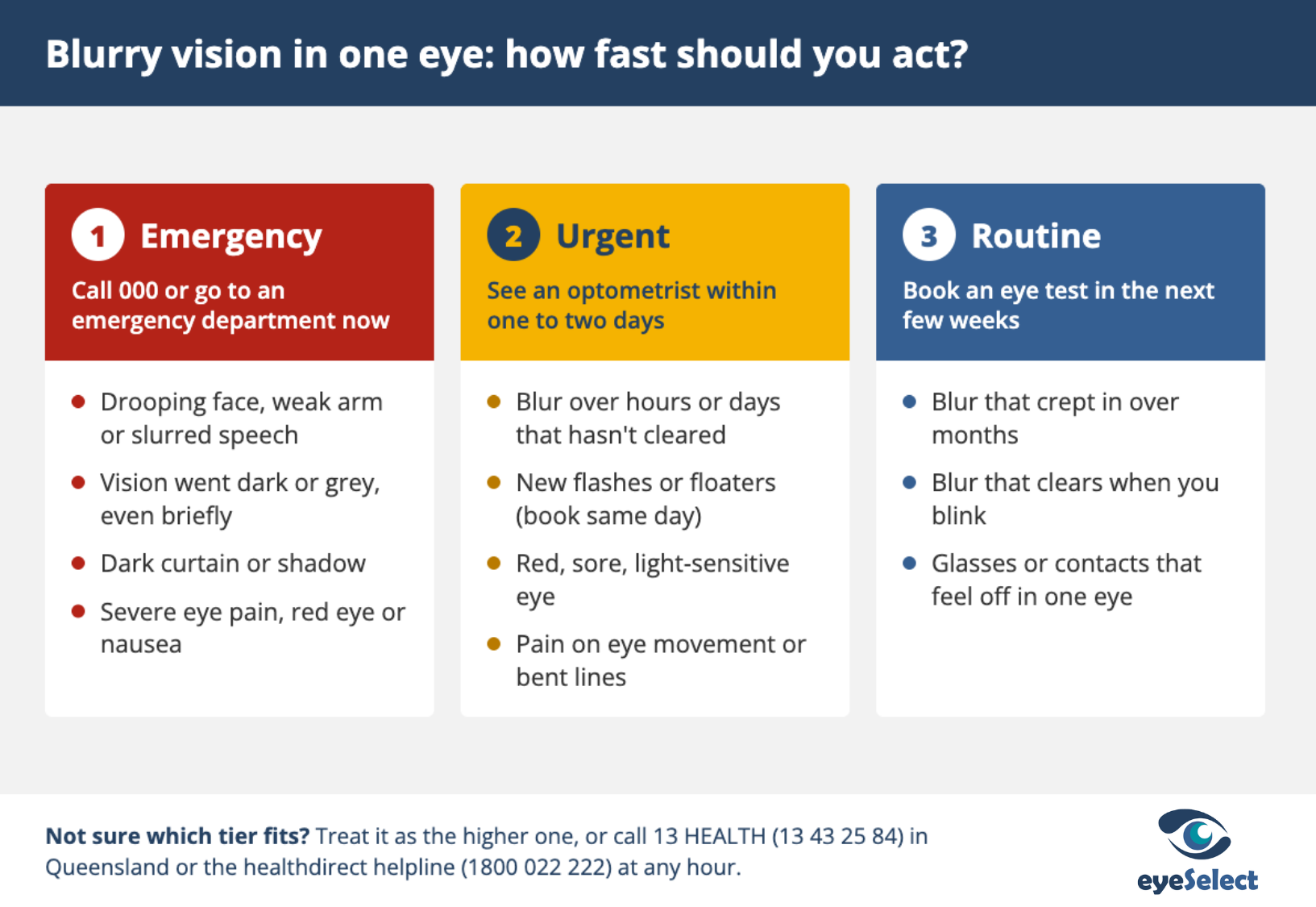
Most blurry vision in one eye comes from something routine, like a prescription that has drifted or a dry patch on the surface of the eye. A few causes are time-critical. How quickly the blur arrived is your best clue, so this guide splits the causes into sudden and gradual.
Why Blurry Vision Can Affect Only One Eye
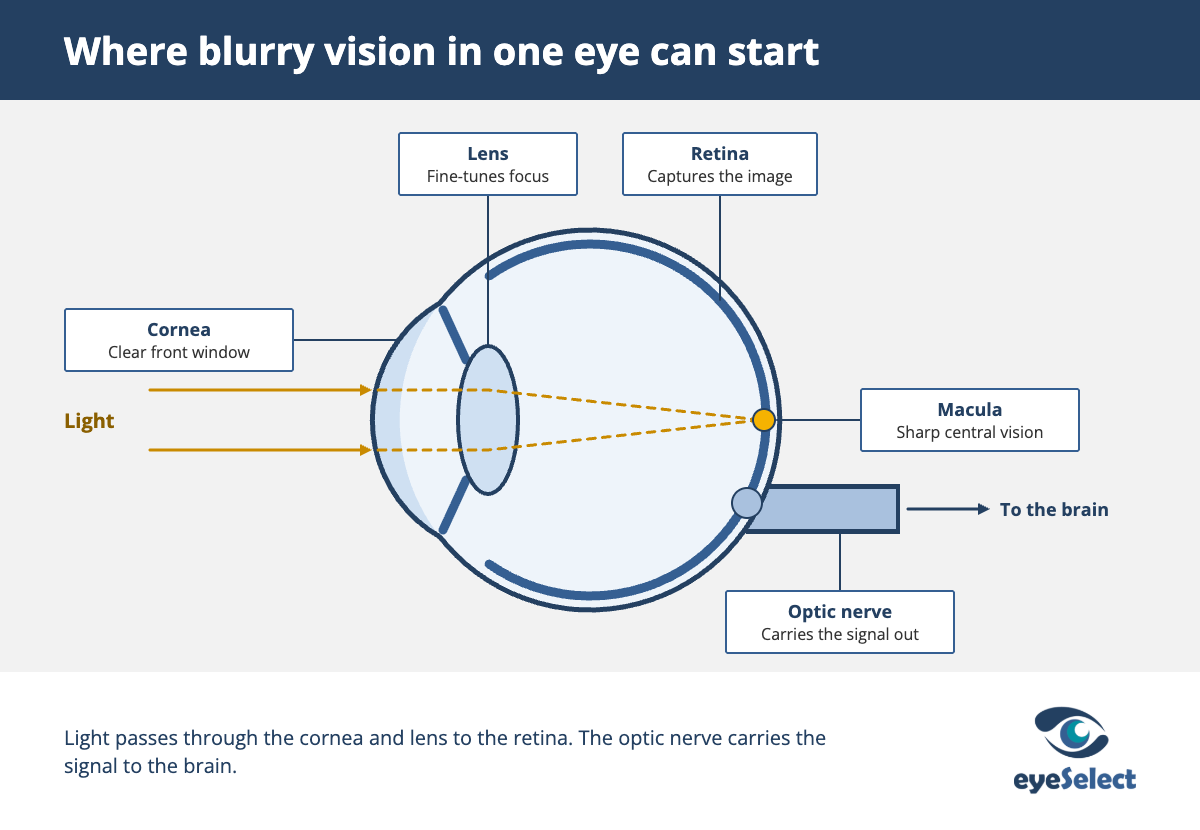
Each eye works as its own camera. The cornea and lens focus light, the retina at the back captures the image and the optic nerve carries it to the brain. A fault anywhere along that path blurs that eye alone.
With both eyes open, your brain leans on the sharper image. A weak eye can hide for months, then seem to appear overnight when you happen to close the good one.
Stroke is the exception. A stroke in the brain’s visual pathways usually removes the same side of the view from both eyes, and many people read that as one bad eye. Checking each eye separately tells the two apart.
Sudden vs Gradual Causes of Blurry Vision in One Eye
Speed of onset sorts most causes into two groups.
| Cause | How fast it appears | Typical clues | How fast to act |
| Sudden causes | |||
| Stroke or mini-stroke (TIA) | Seconds to minutes | Drooping face, weak arm, slurred speech | Call 000 |
| Blocked retinal artery | Seconds to minutes | Painless, severe loss of vision | Emergency department now |
| Retinal tear or detachment | Hours to days | Flashes, new floaters, dark curtain | Same day. Emergency department if a curtain appears |
| Acute angle-closure glaucoma | Hours | Severe pain, red eye, halos, nausea | Emergency department now |
| Corneal scratch or infection | Hours to days | Red, light-sensitive eye, contact lens wear | Optometrist the same day |
| Optic neuritis | Several days | Pain on eye movement, faded colours | Optometrist or GP within one to two days |
| Wet macular degeneration | Days | Bent lines, grey smudge in the centre | Optometrist within one to two days |
| Gradual causes | |||
| Uneven prescription or astigmatism | Months to years | Eye strain, squinting to see clearly | Routine eye test |
| Cataract | Months to years | Hazy vision, glare at night | Routine eye test |
| Dry eye | Comes and goes | Clears with blinking, worse on screens | Routine eye test |
| Keratoconus | Months to years | Ghosting, frequent prescription changes | Eye test within weeks |
| Diabetic eye changes | Weeks to months | Blur that shifts from day to day | Eye test within weeks |
| Long-standing lazy eye | Since childhood | Noticed only when the good eye is covered | Routine eye test |
Sudden Blurry Vision in One Eye: Causes That Need Fast Action
Sudden means anything from seconds to a couple of days. Healthdirect advises urgent medical attention whenever vision blurs suddenly, so treat sudden blurred vision in one eye as urgent until the eye has been examined.
Stroke and Mini-Stroke (TIA)
The Stroke Foundation lists sudden blurring or loss of vision in one or both eyes as a sign of stroke. Run the FAST test:
- Face: has their mouth drooped?
- Arms: can they lift both arms?
- Speech: is it slurred, and do they understand you?
- Time: is critical. Call 000 straight away if you see any of these signs.
Call even if the symptoms pass within minutes. A mini-stroke (transient ischaemic attack) clears by itself and can be a warning of a larger stroke.
A clot can also block the retina’s own artery. This causes sudden, painless and severe loss of vision in one eye, sometimes called an eye stroke. Go straight to an emergency department.
Retinal Tear or Detachment
The retina can tear or peel away from the back of the eye. Early signs are flashes of light and a burst of new floaters. A dark curtain creeping in from the edge of your vision suggests the retina is lifting.
Healthdirect classes retinal detachment as a medical emergency, and Optometry Australia advises seeing your optometrist urgently when flashes arrive with new floaters. Risk is higher if you’re over 50 or highly short-sighted. Our guide to eye floaters explains which floaters need checking.
Acute Angle-Closure Glaucoma
If the eye’s drainage angle closes, pressure climbs within hours. Expect severe eye pain, a red eye, halos around lights and often nausea along with the blur. Healthdirect lists this as an emergency. Go to the hospital straight away to protect your vision.
Corneal Scratches and Infections
A scratch or infection on the cornea, the clear window at the front of the eye, blurs vision and brings redness, watering and light sensitivity. Infections are more common in contact lens wearers. Take your lenses out, leave them out and see an optometrist the same day.
Optic Neuritis
Inflammation of the optic nerve blurs or dims one eye over several days. Colours look washed out and the eye hurts more when you move it. It is sometimes the first sign of multiple sclerosis, so it needs prompt assessment. If the ache is your main symptom, read our guide to pain behind the eye.
Wet Macular Degeneration
In wet macular degeneration, fragile blood vessels leak beneath the macula, the centre of the retina. Door frames start to bend or a grey smudge sits in the middle of whatever you look at. It mostly affects people over 50 and treatment works best when it starts early. An Amsler grid is a quick home check for distortion.
Gradual Blurred Vision in One Eye: Slower Causes
Blur that builds over weeks, months or years is rarely an emergency. It still deserves an eye test, because most of these causes are easier to manage when caught early.
Uneven Prescription and Astigmatism
Your two eyes rarely share the same prescription. If one becomes more short-sighted or long-sighted, or its astigmatism shifts, that eye blurs while the other carries on. It’s one of the most common reasons for slow, one-sided blur, and updated lenses correct it.
Cataract
A cataract is clouding of the lens inside the eye, and it often develops faster in one eye. Vision turns hazy, colours fade and headlights glare at night. Stronger glasses help for a while. After that, surgery replaces the cloudy lens with a clear one.
Dry Eye
Your tear film is the first surface light passes through. When it breaks up, vision smears. Dry eye blur comes and goes, clears for a moment when you blink and gets worse with screens and air conditioning.
Keratoconus
In keratoconus, the cornea thins and bulges into a cone shape. It usually starts in the teens or twenties and often affects one eye first. Clues include ghosting around letters and a prescription that changes at every visit. Our article on keratoconus symptoms lists the early signs.
Diabetes and Diabetic Retinopathy
High blood sugar damages the retina’s small blood vessels over time, a condition called diabetic retinopathy. Blur can also shift from day to day with your glucose levels. Healthdirect recommends an eye check at least every two years if you have diabetes.
Lazy Eye (Amblyopia) Noticed in Adulthood
Some people have had one weaker eye since childhood, often called a lazy eye. The brain relied on the stronger eye, so the difference stayed hidden until something made you cover it. An eye test shows whether the blur is long-standing or new.
Our guide to common eye problems and solutions covers more conditions and how each is treated.
How to Do a Cover Check for Blurry Vision in One Eye at Home
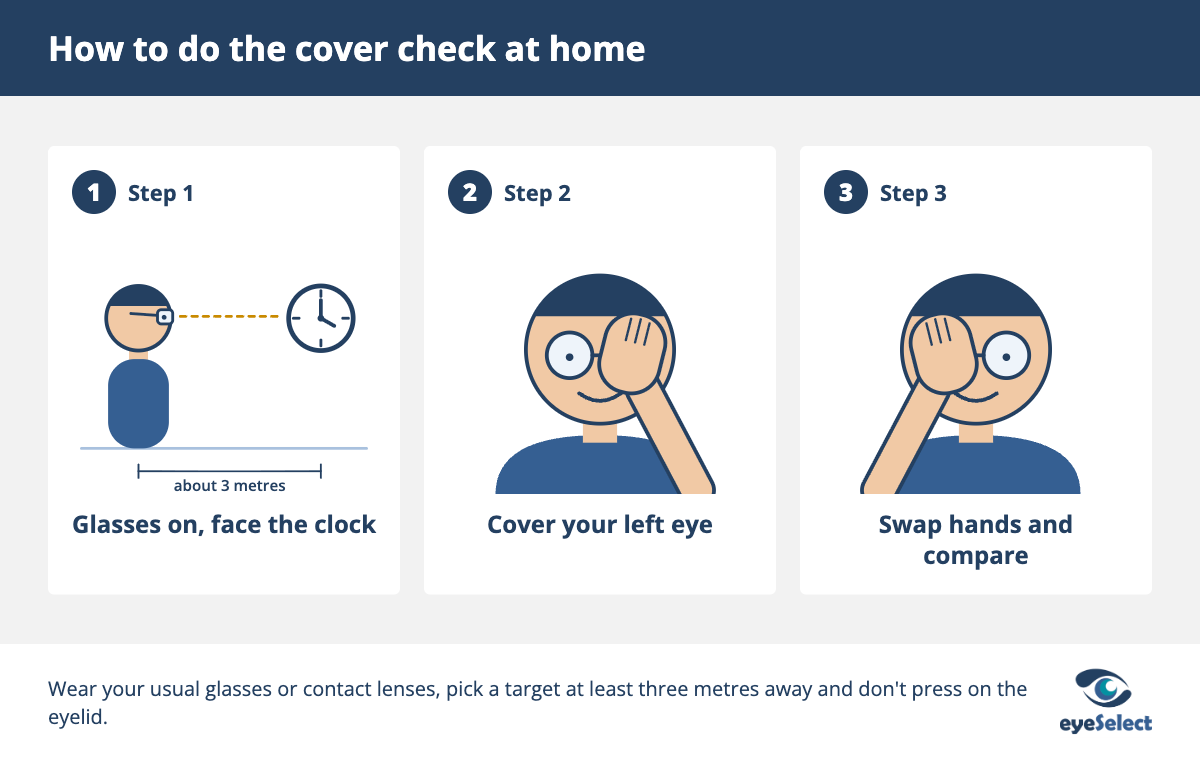
A cover check takes two minutes. It won’t diagnose anything, but it answers the first questions an optometrist will ask: which eye, how blurry and at what distance.
- Wear your usual glasses or contact lenses. You’re testing your everyday vision.
- Pick a distance target. Choose fine detail at least three metres away, such as a number plate or a wall clock.
- Cover your left eye with your palm. Don’t press on the eyelid, because pressure blurs the eye for a minute afterwards.
- Look with your right eye, then swap. Compare how sharp the target is.
- Repeat up close. Test each eye on small print at your normal reading distance.
- Check a straight line. Does a door frame stay straight with each eye?
- Blink a few times. See whether the blur clears.
Note which eye is blurry, whether lines bend, whether blinking helps and when you first noticed it. If the check shows a sudden difference between your eyes, go back to the triage guide at the top of this page.
How to Fix Blurry Vision in One Eye
The fix depends on the cause, which is why an examination comes first.
- Uneven prescription or astigmatism: updated glasses or contact lenses
- Dry eye: lubricating drops and eyelid care
- Cataract: stronger lenses at first, then surgery
- Keratoconus: specialty contact lenses, plus referral for corneal cross-linking if it’s progressing
- Infection or inflammation: prescription eye drops
- Retinal, optic nerve and stroke-related causes: urgent referral to an ophthalmologist or hospital
Lubricating drops and screen breaks are reasonable for blur that clears with blinking. Don’t wait out a sudden change with home remedies.
What a Retinal Photography Appointment Involves
One-sided blur often starts at the back of the eye, where you can’t see it and it doesn’t hurt. Digital retinal photography gives your optometrist a direct view. Here’s how the appointment runs at EyeSelect.
- Your history. We ask when the blur started and what your cover check showed.
- Vision checks. We measure each eye separately to see whether lenses alone restore sharp vision.
- Dilating drops, if needed. Drops widen the pupil for a fuller view. They take about 20 minutes to work.
- The photo. You rest your chin on the camera and look at a target light. There’s a brief flash for each eye. Nothing touches the eye.
- An OCT scan, if needed. Optical coherence tomography maps the retina in cross-section, layer by layer, in a few seconds per eye.
- Your results. Your optometrist takes you through the images in the same visit.
The photo captures the retina, the macula, the optic nerve and the blood vessels that feed them. We keep the images on file for comparison at later visits.
- Allow 20 to 30 minutes, longer with drops or extra scans.
- Drops blur close vision and make lights glare for a few hours. Bring sunglasses and arrange a lift home.
- Comprehensive eye exams at EyeSelect are bulk-billed through Medicare for eligible patients.
When to See an Optometrist About Blurry Vision in One Eye
Any new blur in one eye that lasts more than a day or two is worth an appointment, even if it’s mild. Optometry Australia notes that many eye diseases develop slowly and sometimes without obvious symptoms.
For blurred vision in one eye without emergency signs, an optometrist is a good first stop and you don’t need a referral. Book an eye test online or call Browns Plains on 07 3800 8700 or Forest Lake on 07 3278 7341. If the blur came on suddenly, tell us when you call so we can see you as early as possible.
Frequently Asked Questions About Blurry Vision in One Eye
What causes sudden blurry vision in one eye?
The main causes of sudden blurred vision in one eye are a retinal tear or detachment, a blocked retinal blood vessel, acute angle-closure glaucoma, optic neuritis, a corneal infection and stroke. Several are emergencies. Treat any sudden change as urgent until the eye has been examined.
What is a red flag for blurry vision in one eye?
Red flags are a dark curtain or shadow, new flashes with floaters, severe eye pain with nausea and vision that suddenly drops or goes dark. Blur with a drooping face, a weak arm or slurred speech points to stroke. Call 000 for stroke signs and get emergency or same-day care for the rest.
Can blurry vision in one eye heal on its own?
Sometimes. Blur from dry eye, tired eyes or a minor surface scratch often settles within hours to days. Blur from a cataract, keratoconus or retinal disease won’t clear without treatment. If the blur is sudden or lasts longer than a day or two, have it examined.
How do you fix blurry vision in one eye?
The fix follows the cause. Updated glasses or contact lenses correct an uneven prescription, lubricating drops ease dry eye and surgery removes a cataract. Retinal and optic nerve problems need specialist treatment, sometimes within hours.
Why do I have blurry vision in one eye and a headache?
Common reasons are migraine aura, which usually fades within an hour, and eye strain from an uncorrected prescription. Severe eye pain with a red eye and nausea suggests acute glaucoma. If you’re over 50 with a new headache, a tender scalp or jaw pain when chewing, see a doctor the same day.
Why is one eye blurry after waking up?
Overnight, tears dry out and mucus can settle on the cornea. Pressure from sleeping on that side can add to it. This blur clears within minutes of blinking or with a lubricating drop. If it lasts for hours or returns every morning, book an eye test.
Is sudden blurry vision in one eye that goes away still serious?
It can be. Vision that greys out or goes dark in one eye for a few minutes can be a mini-stroke affecting the eye. The Stroke Foundation says to call 000 for stroke signs no matter how long they last. Blur that clears the moment you blink usually comes from the tear film.
This article is for educational purposes and is not a substitute for professional optometric advice. Book an appointment for a personalised assessment.