

Your eyes well up when you cut onions or walk into a cold wind, and that makes sense. It’s the watering with no obvious trigger that tends to worry people: eyes that stream while you read, water up the moment you wake or blur your vision for no clear reason.
Watery eyes, known medically as epiphora, happen when your eyes either produce more tears than they need or cannot drain them away properly. Most of the time it’s a symptom of something simple and treatable rather than a problem with the eyes themselves.
At EyeSelect, our optometrists see watery eyes constantly, and the cause is rarely what people expect. In this blog you will learn what causes watery eyes, how to stop them at home and when persistent watering is worth getting checked.
How Your Tears Drain (and Why It Matters)
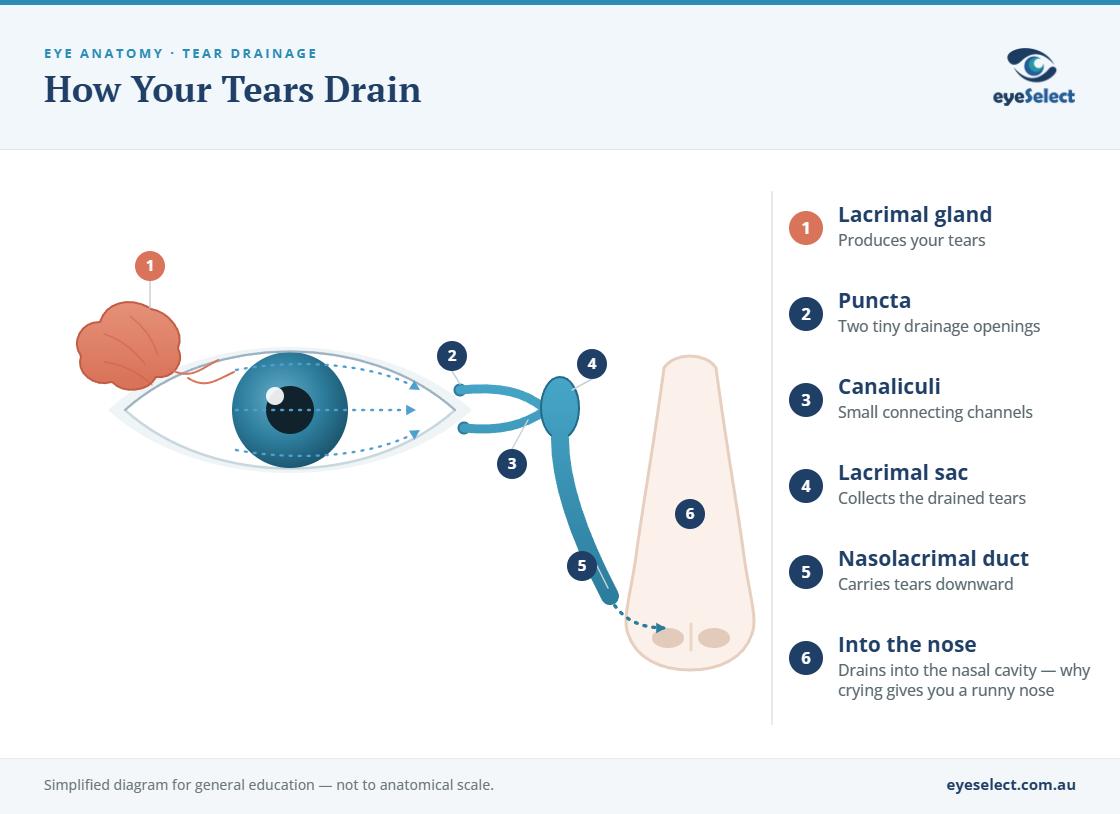
To understand watery eyes, it helps to know where your tears go. Glands above each eye, called the lacrimal glands, produce a thin film of tears. Every blink spreads that film across the surface, then pushes the used tears toward two tiny drainage holes in the inner corner of your eyelids, known as the puncta. From there the tears travel down a narrow channel, the nasolacrimal duct, and into your nose. That’s why a good cry leaves you with a runny nose.
When tear production and drainage stay balanced, you never notice it. Watery eyes show up when that balance tips one of two ways: your eyes make too many tears, or the drainage system is partly blocked and cannot keep up.
What Causes Watery Eyes?
Excess tearing has a long list of possible triggers but a handful account for most cases. These are the ones optometrists see most often.
Dry Eye: The Watery Eye Paradox
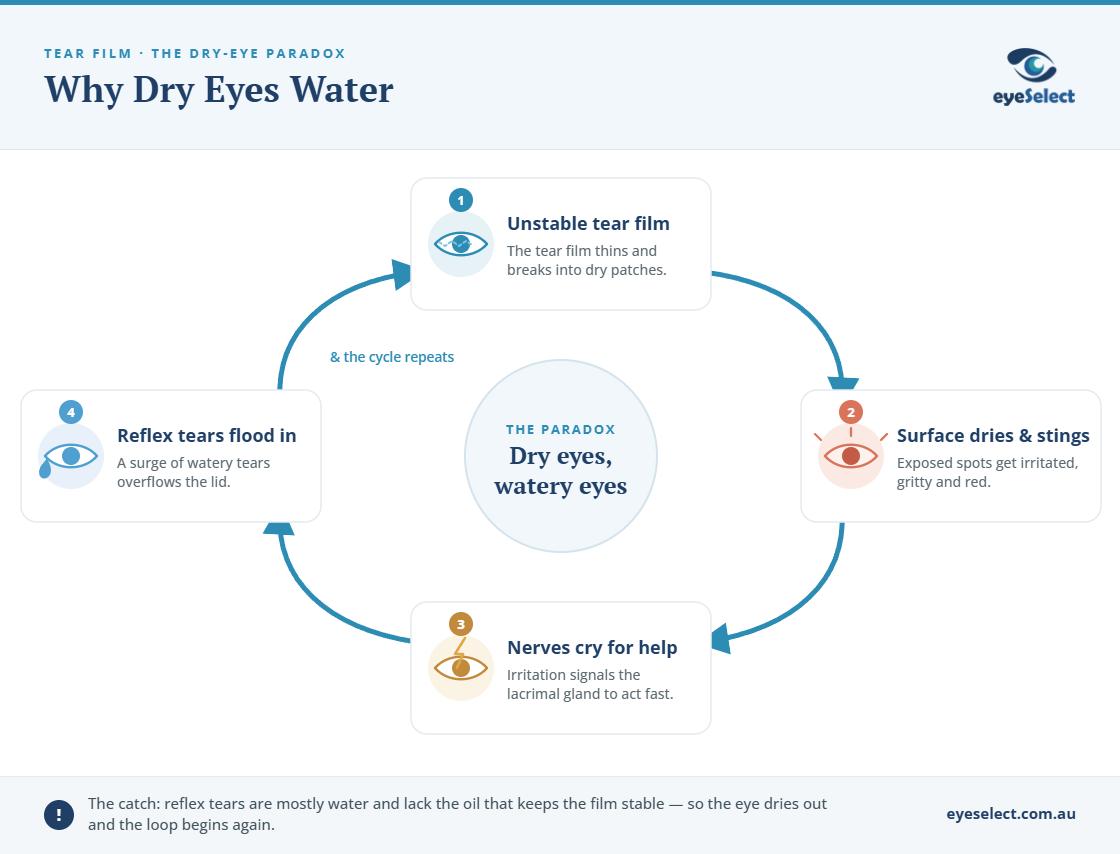
When your eyes are chronically dry, the tear film becomes thin and unstable, which leaves the surface of the eye exposed and irritated. Your eyes respond the only way they know how: they flood themselves with a burst of watery reflex tears.
The catch is that these emergency tears are low in the oils that keep moisture in place, so they do not lubricate well. They simply spill over the edge of your eyelid. The result is an eye that feels gritty and dry yet waters constantly. It’s one of the most common reasons people develop watery eyes, and it is why reaching for more moisture, not less, is often the fix.
If your eyes sting or burn between watering spells, dryness is a likely culprit. You can read more about dry eye treatment options if this sounds like you.
Allergies and Irritants
Allergens such as pollen, dust mites, pet dander and mould trigger the release of histamine, which makes your eyes itchy, red and watery, often alongside sneezing and a runny nose. Hay fever is the classic example. The same protective reflex kicks in with physical irritants like smoke, wind, chlorine, dust, fumes and the odd eyelash that finds its way onto the surface of your eye.
If your eyes are also looking red, our guide to bloodshot eyes explains what is behind the colour.
Blocked or Narrowed Tear Ducts
If the drainage side of the system is the problem, tears have nowhere to go and overflow onto your cheeks. A blocked or narrowed tear duct, called nasolacrimal duct obstruction, is a frequent cause of ongoing watering. It’s especially common in older adults, whose tear ducts naturally narrow with age.
Tearing from a true duct blockage tends to last at least three months, which helps separate it from short-lived irritation. Babies are the other group prone to this, as their tear ducts are still narrow and often do not clear until around their first birthday.
Eyelid Problems
Your eyelids are part of the drainage system too. If a lower lid turns outward, a condition called ectropion, the drainage hole pulls away from the eye and tears run straight down the cheek.
If a lid turns inward, known as entropion, the lashes rub against the eye and set off reflex tearing. Conditions that inflame the eyelid margin, such as blepharitis or a stye, can disrupt the tear film and cause watering as well.
Infections and Waking Up With Watery Eyes
Eye infections such as conjunctivitis, or pink eye, often come with watering, plus redness, discharge or a sticky, crusty feeling. A sinus infection can do it too, since your tear drainage runs into your nose. Watery eyes first thing in the morning are usually down to overnight dryness or blepharitis, where the eyelids do not stay fully closed or the oil glands clog while you sleep.
Watery Eyes Causes at a Glance
| Cause | What it feels like | Tell-tale sign | Where to start |
|---|---|---|---|
| Dry eye (reflex tearing) | Gritty and burning, watery in spells | Eyes feel dry despite the tears | Lubricating eye drops |
| Allergies | Itchy, red and watery | Sneezing, runny nose, seasonal | Antihistamine drops, avoid triggers |
| Blocked tear duct | Constant overflow down the cheek | Builds over months, often one eye | Optometrist assessment |
| Eyelid problems | Watering with irritation | Lid turned in or out, sore margins | Optometrist assessment |
| Infection | Watery, red, sticky discharge | Crusting and grittiness, recent onset | See an optometrist promptly |
How to Stop Watery Eyes
Because watering is usually a symptom, the lasting fix is treating whatever is driving it. A few practical steps help in most cases.
1. Treat the dryness.
Lubricating eye drops or artificial tears settle the surface irritation that sets off reflex tearing, even though adding moisture feels like the opposite of what you need.
2. Manage allergies.
Antihistamine eye drops, avoiding your triggers where you can and a cool compress over closed eyes all calm allergy-related watering.
3. Try a warm compress and lid hygiene.
For blepharitis, clogged oil glands and morning watering, a warm flannel held over the eyes for a few minutes, followed by gently cleaning the lid margins, can make a real difference.
4. Cut the irritants and rest your eyes.
Reduce smoke and screen time, blink more often and flush anything caught in your eye with clean water or saline.
5. Skip the “get the red out” drops.
Regular use of redness-relief drops can cause rebound redness and irritation, which only makes watering worse.
6. Get it checked if it lingers.
Drainage and eyelid problems will not clear with drops alone, so an optometrist needs to take a look.
When Should You See an Optometrist?
Most watery eyes settle once the cause is sorted, but some patterns are worth getting assessed. Book an eye exam if you notice:
- Watering that lasts more than a couple of weeks or keeps coming back
- Tears constantly running down your cheek, which can signal blocked drainage
- Eye pain, light sensitivity or any change in your vision
- Redness, discharge or a sticky, crusty eye
- Watering in one eye only that will not settle
- Watering after an injury or with something stuck in the eye
There’s a simple clue optometrists use:
- If your eyes water but the tears do not spill down your cheek, dryness is often behind it.
- If tears regularly run down your face, a drainage blockage is more likely.
Either way, an exam pins down the cause so you are treating the right thing. Watery eyes paired with blurry vision or pain are always worth checking sooner rather than later.
Get Long-Term Relief from Watery Eyes with EyeSelect
Watery eyes are almost always a message rather than a condition in their own right. More often than not the cause is dry eye, allergies or a drainage issue, and all three are very manageable once you know which one you are dealing with. The trap is assuming watery eyes mean wet eyes, when dryness is frequently the real story.
If your eyes have been watering for weeks, or the watering comes with pain, redness or blurred vision, don’t wait it out. At EyeSelect, our optometrists can examine your tear film, check your drainage and look at the health of your eyelids to find the cause, then recommend treatment that targets it.
We bulk bill eligible Medicare cardholders at both our Browns Plains and Forest Lake clinics.
For more on related conditions, browse our guide to common eye problems and our other blog posts.
This article is for educational purposes and is not a substitute for professional optometric advice. Book an appointment for a personalised assessment.
Book an eye test at Browns Plains or Forest Lake, or call us on 07 3800 8700 (Browns Plains) or 07 3278 7341 (Forest Lake).
Frequently Asked Questions
Why are my eyes so watery all of a sudden?
Sudden watering is usually a reflex response to irritation, dryness or an allergy, as your eyes flush the surface to protect it. It often settles on its own. If it keeps happening or comes with pain, redness or blurred vision, see an optometrist.
Can dry eyes really cause watery eyes?
Yes. When the eye is too dry, the surface gets irritated and triggers a flood of watery reflex tears that spill over instead of lubricating. Treating the dryness, often with lubricating drops, usually calms the watering.
Why do my eyes water in the morning?
Morning watering is commonly caused by overnight dryness or blepharitis, where the eyelids do not close fully or the oil glands clog during sleep. A warm compress and good lid hygiene often help.
How do I stop watery eyes from allergies?
Antihistamine eye drops, avoiding your triggers where possible and a cool compress over closed eyes all help with allergy-related watering. If symptoms are ongoing, an optometrist can recommend a longer-term plan.
Are watery eyes a sign of something serious?
Usually not. Most watery eyes come from dry eye, allergies or a minor irritation. Watering that lasts more than a few weeks, affects one eye or comes with pain, discharge or vision changes is worth getting checked, as it can point to a blocked tear duct or an eyelid problem.